PSEA is a community of education professionals who make a difference in the lives of students every day.
PEARL and Center for Professional Learning
M. Ed. Partnership Program through PennWest U.
Professional Publications Library
As school districts across the commonwealth rethink student cellphone use, a growing number are adopting bell-to-bell restrictions during the school day. A bill working its way through the Legislature would set consistent standards for districts to follow without losing local control. The majority of PSEA members say it’s about time.
Like it or not, we’re all guinea pigs in a global technology experiment decades in the making. And our kids have it the worst. The “smart” device revolution that began in earnest with the release of the first iPhone in 2007 means our current K-12 students have never lived in a disconnected world. Now, everything from our watches to our kitchen appliances conspire to keep us on a perpetual notification loop, feeding hidden algorithms while starving us of the kind of quiet moments that foster reflection and deeper understanding.
That atmosphere of constant distraction is anathema to learning, and it’s wreaking havoc on our kids’ developing brains. Driving everything from drastically shortened attention spans to cyberbullying worries to social media-induced anxiety and depression, every blip, ding, and vibration vying for our kids’ attention has become an alarm bell we can no longer afford to ignore.
Fortunately, action is finally being taken. The last few years have seen a significant uptick in policies meant to address this issue. For years, schools tried half-measures. Phones allowed during lunch. Phones banned during instructional time. Phones tucked into pockets, hoodies, pencil cases, or passed quietly between friends. The results were predictable. Teachers became enforcers. Administrators became referees. And learning continued to lose ground.
In the last few years, a better approach has emerged.
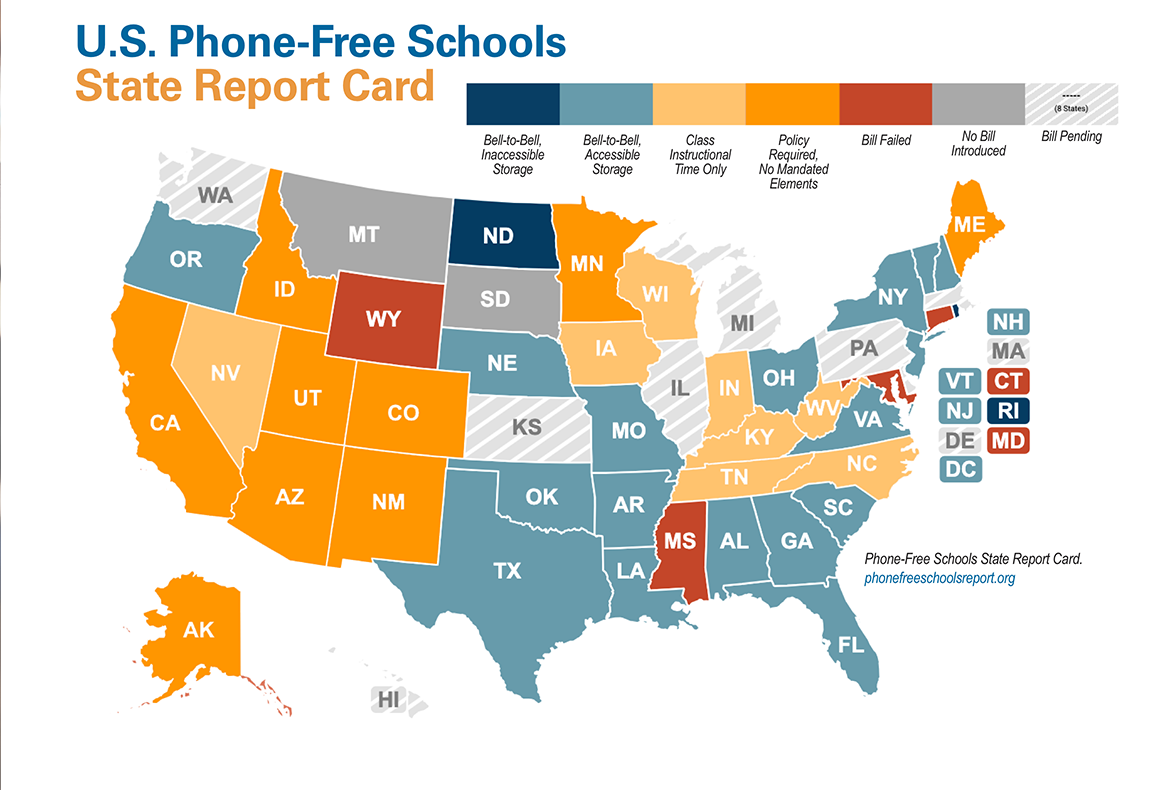
Across the country, lawmakers and school leaders are moving toward “bell-to-bell” policies that remove and/or restrict personal, internet-connected devices from the school day entirely. As of now, 28 U.S. states have some form of school cellphone restriction, with 19 implementing full bell-to-bell policies. Internationally, the trend is even more decisive. Australia banned social media access for anyone under 16 at the end of last year. Spain just followed suit. Similar legislation is moving forward in France and the European Union as a whole. Denmark enacted a bell-to-bell device ban and returned to physical textbooks. Quebec has enforced all-day cellphone restrictions in schools for years.
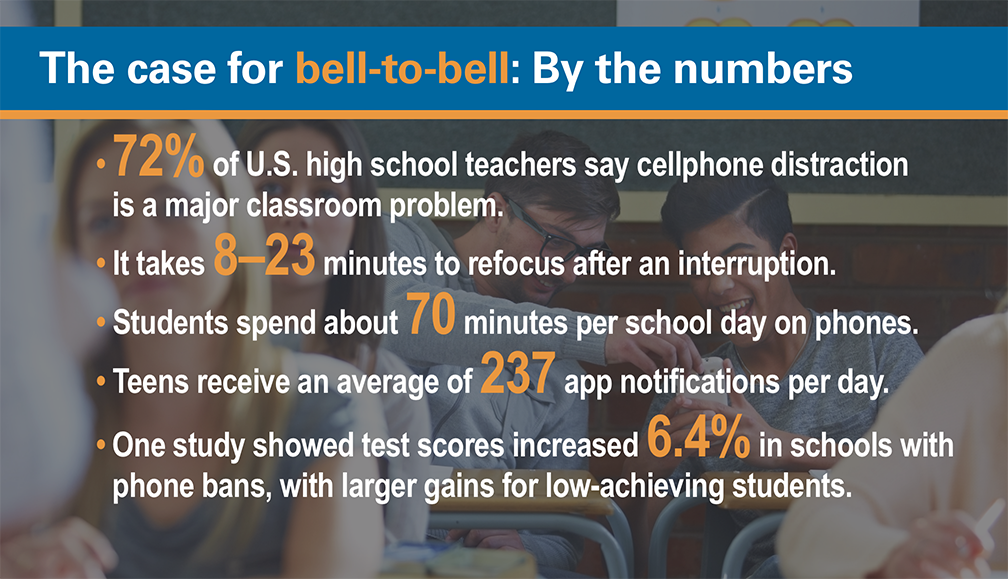
And it’s working. Schools with strict, consistently enforced policies report calmer buildings, fewer conflicts, stronger engagement, and improved academic focus. Research backs this up. It can take anywhere from eight to 23 minutes for the average person to refocus on a task after an interruption. The average teen receives 237 app notifications per day and spends roughly 70 minutes of the school day on their phone. That adds up to the loss of nearly an entire instructional day every week.
“Imagine you are in your world on your phone in the hallway for four minutes, and then you go back into the classroom,” said Kristen Beddard, co-lead of PA Unplugged, an advocacy group that is helping lead the charge to keep kids away from their phones during the school day. “These teachers are having to wait anywhere from 10 to 20 minutes for kids to finally get back into what they should be thinking about.”

That burden is exactly what educators say has become unsustainable.
“Over the last 10 years too much of the day-to-day energies and efforts of teachers have revolved around limiting or eliminating cellphone and technology use by students during class time,” said Andrew Baxter, a high school social studies teacher in the Quakertown Community School District. “What’s needed is a comprehensive statewide ban that takes phones out of the hands of students during school hours allowing teachers to focus on their primary and essential role of providing valuable learning experiences for students.”
The National Association of School Resource Officers agrees. In an October statement, NASRO explicitly endorsed bell-to-bell policies, warning that phone access during the school day undermines both safety and learning.
“Access to phones during the school day reduces student safety in normal and especially emergency situations,” the organization said in a statement. “During normal days, phone access promotes social media drama and cyberbullying and makes it easier for students to plan physical altercations.”
Teachers see that reality every day.
“I spend way too much time each period telling students to put their phones away,” said Tony Bajor, a teacher in the Delaware Valley Education Association. “It is taking away from valuable class time and is a major distraction to the students.”

In districts that have already made the leap, the changes are immediate.
At Derry Area School District in Westmoreland County, a bell-to-bell policy went into effect for the 2025–26 school year. Phones are locked in lockers in the middle school and placed in classroom holders at the high school.
“There’s not the nervous tick anymore of, ‘Oh, we got to check our phones,’” said Michael Moximchalk, an eighth-grade American Cultures teacher and president of the Derry Area Education Association. “There’s much more one-on-one communication.”
He’s seen phone-related discipline referrals drop sharply, student drama decrease dramatically, and less stress put on teachers to play cat-and-mouse with students always looking for loopholes.
Counselors at McDowell Intermediate High School in the Millcreek Township School District report similar outcomes.
“Since implementing a no cellphone policy at McDowell, the difference has been incredible,” wrote School Counselors Remle Moyak, Jessie Zablotny, Robert Marriott, and Carlene Murray in testimony to the state House Health Committee in October. “Students are more focused, engaged, and willing to participate. There’s more laughter, more conversation, and stronger friendships forming.”
They also noted a drop in cyberbullying and social media pressures and a calmer, happier school environment overall.
Pennsylvania currently ranks near the bottom nationally when it comes to strong, enforceable phone-free school policies. That may soon change.
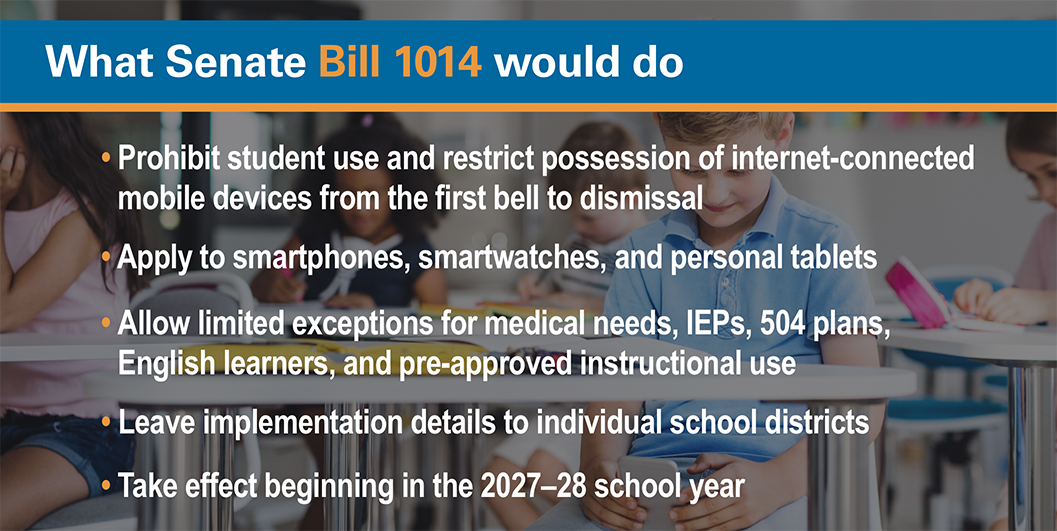
In February, the state Senate passed Senate Bill 1014 by a vote of 46-1, which would require public school districts to adopt bell-to-bell policies restricting student possession and prohibiting student use of personal internet-connected mobile devices during the school day. Now the bill goes to the House of Representatives for consideration.
“We thank Sens. Robinson, Santarsiero, and Hughes for leading a bipartisan coalition to take this important step, which will support Pennsylvania’s 1.7 million public school students, their overall well-being, and their academic achievement,” said PSEA Vice President Jeff Ney, who testified before the state House Education and Health committees on this issue in
November. Ney also addressed a frequently stated concern among parents.
“I know that many of us worry about what greater restrictions on student mobile devices might mean in an emergency,” he said. “Security experts tell us that mobile devices often get in the way of students listening to and following directions during emergency situations at school.”
How these policies are implemented should be left up to each individual school district, Ney said, and the state should not interfere with school districts that have already successfully restricted student possession and use of mobile devices. That language is written into Senate Bill 1014.
The important thing, educators across the commonwealth agree, is that enacting a clear statewide policy matters.
“Without statewide backing, the progress we have made will erode away,” said Max Kraft, a teacher in the Bethlehem Area School District, which has had an instructional-time no-cellphones policy in place since the 2023-24 school year. “Senate Bill 1014 would give districts the muscle to enforce rules consistently.”

Few educators pretend that restricting cellphones will solve every problem facing schools. But many see it as a necessary first step.
“Cellphone bans are not a panacea,” Kraft said. “But legislation like this gives me a little hope that we can move the needle in a positive direction.”
Others frame it even more bluntly, with one teacher saying that getting students to look up from their phones to pay attention is 90 percent of the battle now.
“Reclaiming our students’ attention is not just a sound policy proposal, but a wise and compassionate choice,” said Steve Kelly, a librarian in the Lower Moreland Township School District.
The bottom line is we can’t afford to do nothing. Bell-to-bell, phone-free school policies are the most logical response to a problem educators say has become impossible to manage alone. For PSEA members, the question is no longer whether phones interfere with learning. It’s whether the state is ready to back up their calls to do something about it. Fortunately for us all, it looks like we’re headed that way.